
Nanowire device for single virus delivery and sensing in vacuum
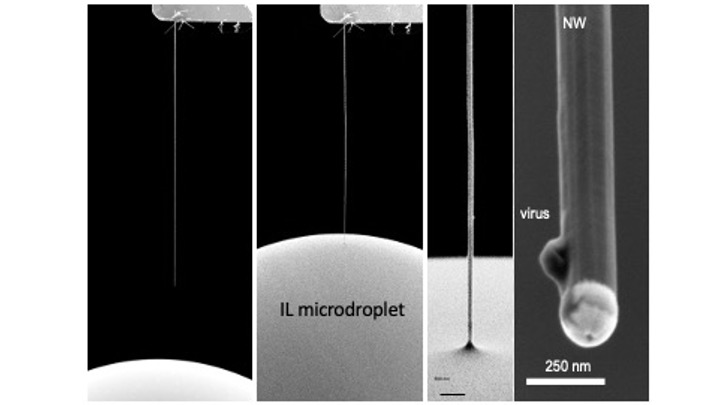
VIR-Quantify aim has been to prove a new technology for fast, untargeted, and highly sensitive virus detection. By combining ionic liquids for structural preservation with nanowire sensors, it uniquely measures particle mass and stiffness with high throughput (30 particles/minute) directly in liquid samples without losing analytes.

Project Number: 101157423
Project Acronym: VIR-Quantify
Project title: Nanowire device for single virus delivery and sensing in vacuum
Vir-Quantify technology
Why Vir-Quantify research matters
Airborne viruses causing respiratory diseases represent a mayor global health threat, being viruses with RNA-genomes from animal reservoirs highly likely to cause public health emergencies in the future. VIR-Quantify aimed[BN1] to provide proof of concept for a technology capable of highly sensitive, fast and untargeted airborne virus detection with infectivity assessment, providing a comparative advantage in the competitive landscape. VIR-Quantify builds upon an unprecedented application of NMS sensors to the field of airborne viral particles detection. VIR-Quantify proposes the use of ionic liquids to preserve the virus structure, together nanowire sensors that allow mass and stiffness measurements for identification and infectivity studies of the pathogens. The innovative solution lies in two fronts: 1) an unprecedented capability to measure with high throughput (30 particles/minute) the stiffness of intact viruses to infer their infectivity potential, not at reach to other techniques; 2) the capability to count and characterize all the viral particles present in the liquid sample without loss of bioanalytes during the measurements.
VIR-Quantify aimed to exploit this novel technology for on-site identification and quantification of airborne viral particles and validate the innovation potential of such technological tool for commercialization by developing a market entry strategy built upon IPR consolidation and spin-off set-up. This will lead to high-gain, disruptive outcomes in the form of unprecedented mechanistic understanding for detecting the quick spread of airborne viral particles with great socioeconomic benefits visible at three levels: (1) fueling industrial innovation and economic growth in a game-changing sector (preventive medicine); (2) reducing healthcare costs worldwide, thus enabling more resilient and efficient health systems; (3) improving human welfare.